


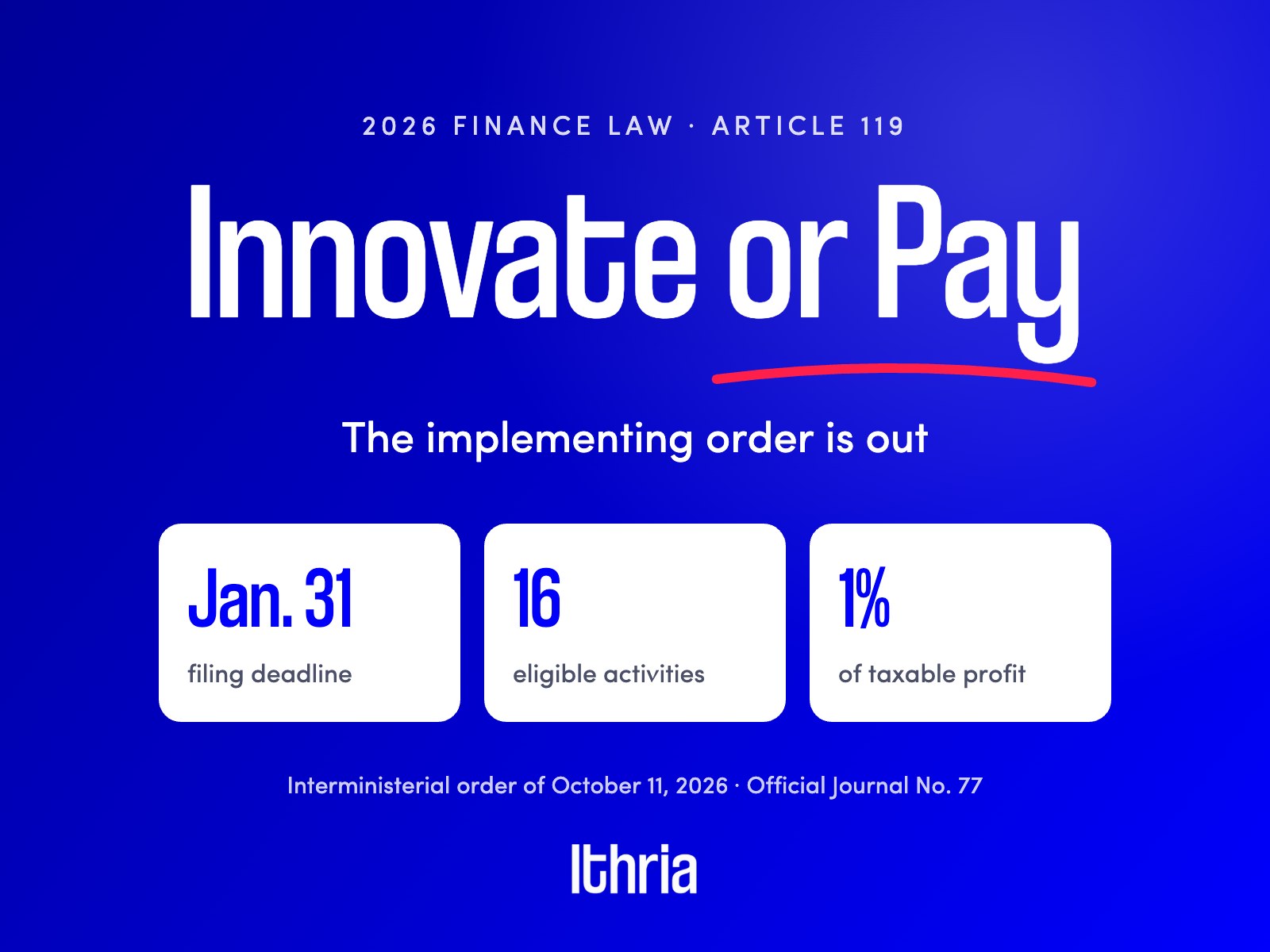
In a first article (in French), we outlined the obligation created by Article 119 of Algeria’s 2026 Finance Law, which requires companies to devote at least 1% of their taxable profit to research, development or innovation (R&D&I) every year. The sectors concerned and the rules for applying the tax remained to be set.
That is now done for the “Innovate or Pay” mechanism, as the ministry’s startup directorate calls it. The interministerial order of October 11, 2026, signed by Mohammed Lamine Lebbou, Minister of Finance, and Noureddine Ouadah, Minister of Knowledge Economy, Startups and Micro-enterprises, was published in Official Journal No. 77 of November 4, 2026 (pages 20 to 26). It sets out the filing platform, the deadline, the list of eligible expenses, the supporting documents and how the tax is paid.
Key takeaways
- Interministerial order of October 11, 2026, published in Official Journal No. 77 of November 4, 2026.
- Filing on innovation.gov.dz only, before January 31 each year.
- An electronic statement of expenses to attach to the annual tax return.
- In-house R&D and 16 activities carried out with the ecosystem, grouped into five families.
- Deferral to the following financial year possible, with a commitment.
- Tax equal to the gap between 1% and the ratio actually invested, paid to the tax collector, with the receipt uploaded within 10 days.
Who is covered by the order?
- All business sectors are covered (Art. 2).
- The obligation applies to entities incorporated under Algerian law with annual revenue of at least DZD 2 billion.
- They must devote at least 1% of the financial year’s taxable profit to R&D&I every year.
- These activities are carried out within the company or through open innovation programs with labeled startups, scale-ups or incubators (Art. 3). Scale-ups are a new addition compared with the Finance Law.
How do you declare your R&D spending?
- Incur and document the expenses during the financial year to which the profit relates.
- Before January 31 each year, declare the amounts exclusively on the innovation.gov.dz platform, run by the ministry in charge of startups, and upload the supporting documents (Art. 4 and 5).
- Once the declared activities and documents have been checked for compliance, the company downloads its “Electronic statement of expenses”, secured with a QR code (Art. 6 and Annex 2).
- This statement must be submitted to the tax authorities together with the annual tax return (Art. 7).
For the 2026 financial year, the first filing deadline on the platform should therefore be January 31, 2027. The electronic statement becomes the key document of the system, since it is what proves the expenses actually incurred to the tax authorities.
What do the three annexes of the order contain?
The order comes with three annexes. The first lists eligible expenses and their supporting documents, the second sets the template for the electronic statement of expenses and the third the template for the deferral commitment. We reproduce them below with the key points to remember. The official text is on pages 21 to 26 of Official Journal No. 77 (in French).
Annex 1. Eligible activities and supporting documents
This is the most important annex, since only the expenses it lists can be declared on the platform (Art. 4). It contains 16 activities grouped into five families, all open to every sector. Three points help to read it.
- Each activity has its own list of documents, which the ministry uses to check that the declaration complies (Art. 6).
- The partner’s label is almost always required (startup, scale-up, incubator or innovative project). Check it before signing.
- Proof of payment is required for most activities, in addition to the contract or invoice.
1. Use of innovation and R&D results
- Acquisition of a technology solution from a startup or scale-up. Direct purchase of a product or service supplied by a startup or scale-up.
Supporting documents. Purchase order or invoice, proof of payment, copy of the startup or scale-up label. - Open innovation contract. Expenses related to open innovation or applied R&D projects with a startup, scale-up or incubator.
Supporting documents. Open innovation contract, proof of payment, copy of the incubator, startup or scale-up label. - R&D subcontracting contract. Outsourcing of R&D work to a research laboratory or research center, including feasibility studies, prototyping and testing.
Supporting documents. R&D subcontracting contract, proof of payment. - Acquisition of exploitation rights. Technology protected by a patent, copyright or related rights, resulting from R&D and innovation work.
Supporting documents. Patent certificate from INAPI or the international PCT system, or ONDA registration certificate, proof of payment, copy of the innovative project, startup or scale-up label. - Acquisition of a product or service labeled “innovative project”. Product or service resulting from an R&D&I effort, with demonstrable technological or functional novelty.
Supporting documents. Invoices for the product or service, copy of its innovative project label.
2. Direct investment in innovation
- Direct investment in a startup or scale-up. Direct equity stake to support its development or build a strategic partnership.
Supporting documents. Shareholders’ agreement, transfer or proof of transfer of the paid-up funds, updated articles of association published in the BOAL (official legal notices bulletin), copy of the startup or scale-up label.
3. Investments through the financial market
- Purchase of listed shares. Shares of a joint-stock company labeled startup or scale-up and listed on the stock exchange, to support its financing and post-IPO growth.
Supporting documents. Proof of payment of the amount invested, securities account statement and transaction record, copy of the label. - Investment in a fund (FCPR, SICAR, SCI…). Creation of or subscription to a fund that finances a portfolio of startups or scale-ups.
Supporting documents. FCPR fund rules, registration of the units in the company’s name with the custodian, articles of association of the SICAR, or articles of association and investment policy of the SCI. - Equity crowdfunding. Contribution, through an equity crowdfunding platform, to innovative startups or scale-ups at seed or growth stage.
Supporting documents. Proof of payment, copy of the startup or scale-up label. - Sukuk. Subscription to sukuk dedicated to financing innovation, compliant with Islamic finance.
Supporting documents. Sukuk investment certificate, proof of payment, copy of the innovative project, startup or scale-up label.
4. Partnerships with research institutions
- Postdoctoral researchers. Compensation of a postdoctoral researcher on an applied research project generating new technologies, prototypes, publications or patents useful to industry.
Supporting documents. Fixed-term employment contract, doctoral degree, proof of payment. - Paid R&D internships. Interns in technology programs (master’s, engineering, PhD) working on research and innovation projects within the company for 6 to 12 months.
Supporting documents. 6- to 12-month internship agreement, interns’ pay slips. - Funding a research project. Project carried out by a university or public research center on an issue identified by the company.
Supporting documents. Collaborative research agreement, invoices and expense records. - Permanent researchers or faculty researchers. Temporary hosting within the company of researchers holding at least a doctorate, for R&D or technology transfer assignments.
Supporting documents. Proof of salary or allowances, degree.
5. Innovation support structures
- Acceleration program with Algeria Venture. Program to develop startups, scale-ups or innovative projects.
Supporting documents. Funding invoices, acceleration contract. - Funding a labeled incubator, accelerator or fablab. Structure dedicated to supporting startups and prototyping.
Supporting documents. Copy of the incubator label, proof of spending on technology prototyping equipment.
What about in-house R&D?
The order explicitly recognizes it (Art. 3), without assigning it a list of documents in Annex 1. The company must therefore demonstrate itself that its internal spending served a research or innovation effort. This requires an identified project, a novelty objective, attributable costs (team time, equipment, services) and, ideally, expenses recorded as assets, such as capitalized development costs.
Companies that manage their projects in a dedicated tool, such as Ithria, have this traceability as they go, with each project’s objectives, milestones, time spent and costs incurred. Since Ithria is a labeled startup, spending with it is itself covered by Annex 1.
Annex 2. Template for the electronic statement of expenses
This document is issued through the platform once the declaration has been processed (Art. 6). It is secured with a QR code and must be submitted to the tax authorities with the annual tax return (Art. 7).
What the statement contains
- The company’s name and business activity.
- The tax identification number (NIF) and trade register number.
- Address, phone number and email.
- The financial year concerned.
- A table showing, for each business sector, the activities and the amount of expenses, with the total.
- The date the statement was issued.
Key point. This statement, drawn up from the data and documents you uploaded, certifies your expenses to the tax authorities. You need it in hand when filing the annual tax return, and the NIF, trade register number and financial year must match your tax return.
Annex 3. Template for the deferral commitment
It is used when R&D&I activities are carried out during the financial year following the one in which the profit was made. The company signs it and uploads it to the platform, then attaches it to its annual tax return (Art. 8).
What the commitment contains
- The signatory’s identity and capacity as the company’s representative.
- The company’s name, activity, NIF, trade register number, address, phone number and email.
- The financial year covered by the commitment.
The company makes two commitments.
- To devote, during the following financial year, at least 1% of the taxable profit of the financial year concerned to activities listed in Annex 1, and to declare these expenses on the platform.
- Failing that, to pay the tax due for the financial year concerned to the competent local tax collector.
The document ends with the place, date, company stamp and signature. A note states that it is attached to the annual tax return for the financial year in respect of which it is signed.
Key point. Deferral grants one extra year and formally commits the company to paying the tax if the spending does not follow (Art. 12). It is best kept for projects that are genuinely scheduled.
What happens if the minimum is not reached?
The research, development or innovation tax applies (Art. 9). Its rate equals the positive difference between the legal rate of 1% and the ratio of spending actually devoted to R&D&I (Art. 10).
Tax rate = 1% − (R&D&I spending for the year ÷ taxable profit for the financial year)
Only the gap is taxed. Using the example from our first article (taxable profit of DZD 500 million, DZD 2 million invested), the tax comes to DZD 3 million, exactly the share of the minimum that was not invested.
For payment, the order sets out three steps (Art. 11).
- The tax is paid to the competent local tax collector.
- The receipt is uploaded to the platform within 10 days of payment.
- It is also attached to the annual tax return and to the electronic statement of expenses.
Chemseddine Bemmoussat, Director of Startups and Support Structures at the Ministry of Knowledge Economy, Startups and Micro-enterprises, encourages business leaders to see this amount differently.
“This is no longer a tax, it is your future budget for competitiveness, decarbonization, and technological sovereignty.”
Chemseddine Bemmoussat, Director of Startups and Support Structures
A strong signal for the whole ecosystem
The text mobilizes the whole ecosystem. Universities, laboratories, incubators, startups and doctoral students are being called on to offer partnerships to the companies concerned, which will see their choice of partners widen. To choose well, check that the partner holds the label required by Annex 1 and formalize each collaboration with a contract or agreement, since these are the documents the platform will ask for.
“A qualitative legislative and economic leap that connects Algerian universities, incubators and startups with their economic and industrial environment.”
Prof. Ahmed Mir
Your checklist before January 31
- Check the threshold (revenue ≥ DZD 2 billion) and estimate 1% of the projected taxable profit.
- List the expenses already incurred this year that fall within one of the five families of Annex 1.
- Gather the supporting documents, namely contracts, invoices, proof of payment and copies of your partners’ labels.
- Document in-house R&D project by project, with the related costs.
- Close the gap before year-end, or prepare the deferral commitment.
- Set up your access to innovation.gov.dz and allow for processing time, so you have the electronic statement when filing your tax return.
Frequently asked questions
Entities incorporated under Algerian law, in every sector, with annual revenue of DZD 2 billion or more. They must devote at least 1% of their taxable profit to research, development or innovation every year.
Expenses are declared before January 31 each year, only on the innovation.gov.dz platform. For the 2026 financial year, the first deadline should therefore be January 31, 2027.
Annex 1 of the order lists 16 activities grouped into five families. They range from buying solutions from labeled startups to open innovation, R&D subcontracting, patent licenses, equity stakes, investment funds, sukuk, research partnerships, R&D internships and funding for incubators or Algeria Venture programs.
Yes. Article 3 of the order recognizes R&D carried out within the company. The company must then demonstrate that its internal spending served an identified research or innovation project, with attributable costs.
Its rate equals 1% minus the ratio of R&D&I spending to taxable profit. Only the gap from the minimum is taxed. The tax is paid to the tax collector and the receipt is uploaded to the platform within 10 days.
Yes, by signing the commitment set out in Annex 3 on the platform and attaching it to the annual tax return. If the commitment is not honored, the tax is due.
It is the QR-code-secured document issued by the platform after the declaration has been checked. It must be submitted to the tax authorities with the annual tax return.
Where does your company stand?
Our team reviews the threshold, eligible expenses, supporting documents and filing on the platform with you during a free assessment.
This article presents the texts for information purposes only and does not constitute tax advice. Reference texts. Article 119 of Law No. 25-17 of December 14, 2025 on the 2026 Finance Law, and the interministerial order of 29 Rabie Ethani 1448 corresponding to October 11, 2026 setting the business sectors concerned by research, development or innovation activities and the rules for applying the research, development or innovation tax, Official Journal No. 77 of November 4, 2026, pages 20 to 26.